The Old Family
and how we got here
Neil or Neal Harley is Owen Harley's father, given by Familysearch but also by family research conducted by Anna Harley from Australia. He lived his days in Braade in a very poor part of Donegal. We only know that he was a farmer but it would be useful to know more about the lifestyle of a farmer in Donegal at that time. The Donegal Genealogy Resources Website is a good starting point and gives us a 1901 census record from Braade.
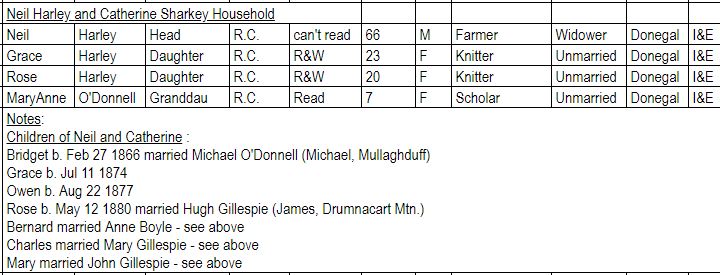
This is useful information but what is fascinating is the extra social history which can be gleaned from the rest of the census entry from Braade in 1901. The history of Ireland is complex and too large a subject to be explained here. However, a knowledge of the Penal Codes might explain why the people here were in severe poverty.
In the census for Braade absolutely everyone is Roman Catholic. All speak Irish and English except three children under school age who speak only Irish. This suggests that Irish was spoken at home and English was learned at school.
Most people over the age of 35 can't read and most under that age can, although there are exceptions both ways, even in the same family. In addition, of the over 35s, 8 males are literate and 12 illiterate while the women have a ratio of 2/16 suggesting that education had been reserved predominantly for males but in the under 35s the gender difference has disappeared. The literacy/illiteracy ratio is still 36/21 though. For the start of the 20th century that is an amazing figure. It looks as though most stay in education until they are between 12 and 14 by 1901 although one 8-year-old isn't listed as a scholar and another is listed as a domestic servant - and there is still a 10-year-old domestic servant in the 1911 census!. There is a 12-year-old knitter and, in fact, almost all girls and women in employment are knitters. Most working men are farmers or "farmer's sons" and some women are "farmer's daughters".
We have one 98 year old in the village which is an astounding age, given the living conditions, but I'll admit to being sceptical about the accuracy of the reported ages as there are major discrepancies between the ages given to the same individuals in the 1901 and 1911 censuses. For example, James and Anne Healy go from 50 to 70 in the ten years while their children age by 10,10, 9 and 8 years. On the whole, young people's ages are fairly close to 10 years different whereas older people vary enormously, suggesting either that they didn't know what age they were or that younger members of the family gave the figures. Parents generally know how old their children are but children don't necessarily know how old their parents are.
Finally, there are 7 Sharkey households, 6 Boyle households, 5 Harley, 4 Gillespie, 2 Duffy and 1 each of Healy and Houston with much intermarrying as well. The re-use of Christian names, which was an Irish as well as Scottish tradition, gives a clue as to the relationships between the households.
Neil's wife Kitty or Kate Sharkey is gone by 1901 and Neil doesn't feature in the 1911 census suggesting that he too has died by then. We know nothing of Kitty but there are seven Sharkey households in the village so we can assume that she was a local lass through and through.
For a description of life in The Rosses, the area the Harleys lived and worked in, see this article.